Understanding Kidney Stones: Causes, Prevention & Treatment Option
Understanding Kidney Stones
Causes, prevention, and treatment options—explained simply.
Kidney stones are common, but understanding why they form and knowing your treatment options can make a difficult experience much easier to navigate.
Schedule an Appointment
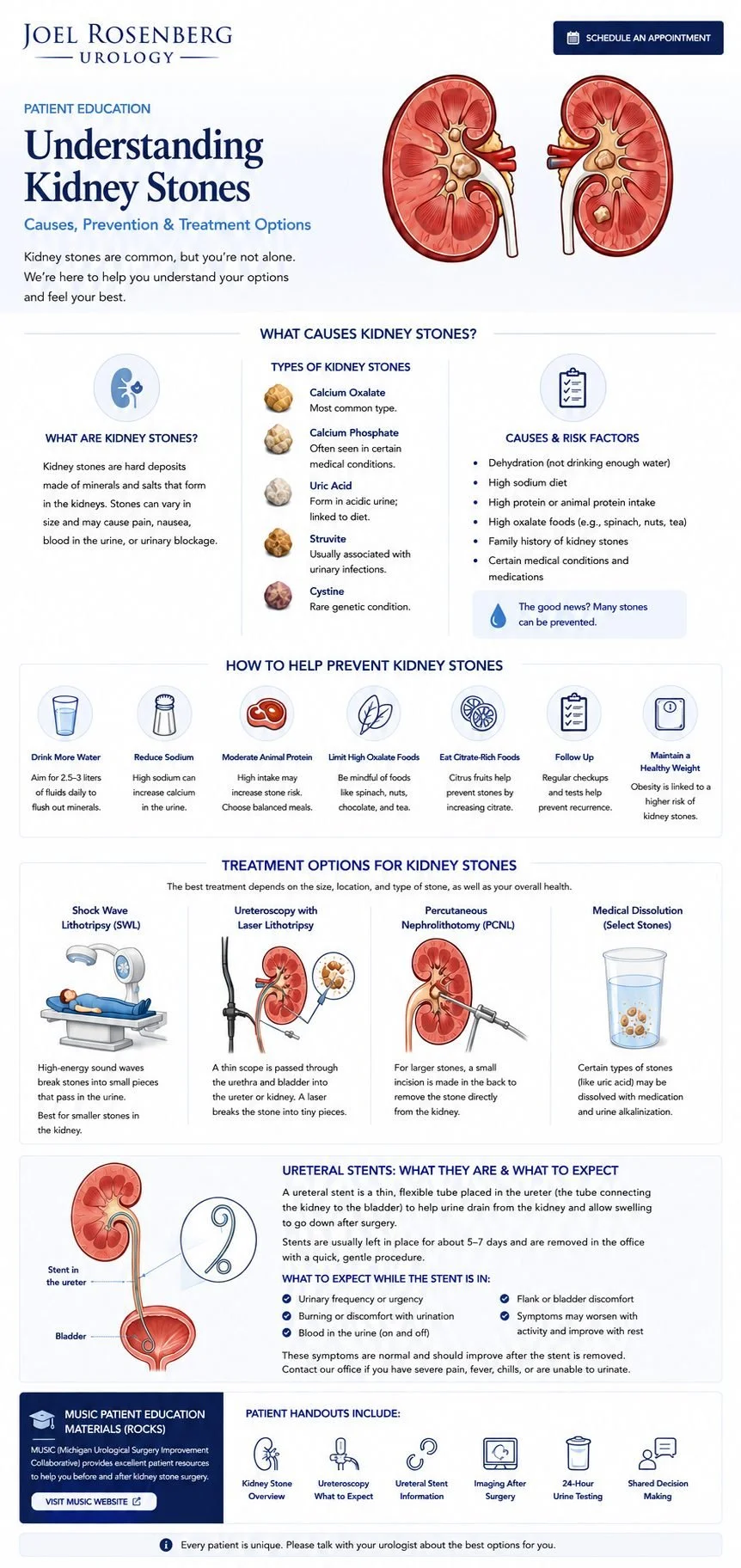
What is a kidney stone?
A kidney stone is a hard deposit made from minerals and salts that form inside the kidney. A stone may remain in the kidney without causing symptoms, or it may move into the ureter and cause pain, blood in the urine, nausea, or blockage.
Why they hurt
Pain often occurs when a stone moves into the ureter and interferes with the normal flow of urine.
Not every stone needs surgery
Small stones that are likely to pass and are not causing complications can sometimes be monitored.
Prevention matters
For many patients, hydration, diet changes, medications, and urine testing can reduce the chance of another stone.
What causes kidney stones?
Stones usually form because the urine becomes concentrated with substances that can crystallize. Several factors can contribute at the same time.
Dehydration
Not making enough urine allows stone-forming minerals to become more concentrated.
Diet
High sodium intake and certain dietary patterns can increase the risk of stone formation.
Urine chemistry
Higher urine calcium, oxalate, uric acid, or lower citrate can increase risk in some patients.
Family history
Some people are genetically more likely to form stones.
Medical conditions
Certain health conditions can alter urine chemistry and increase stone risk.
Medications
Some medications can influence the substances found in urine and contribute to stone formation.
The most common types of kidney stones
Calcium Oxalate
The most common type. Prevention often focuses on fluids, sodium reduction, normal dietary calcium, and targeted dietary changes.
Calcium Phosphate
Urine calcium, citrate, and urine pH can influence formation.
Uric Acid
Often associated with acidic urine. Selected stones can sometimes be dissolved by alkalinizing the urine.
Struvite
Associated with certain urinary infections and may grow quickly.
Cystine
A less common inherited stone disorder requiring individualized prevention.
How to reduce your risk of another stone
Drink more water
Aim for enough fluid to keep urine dilute. Your urologist can personalize your target using a 24-hour urine collection.
Reduce sodium
Lowering salt intake can reduce urinary calcium in many calcium-stone formers.
Keep normal dietary calcium
For calcium oxalate stones, avoiding dietary calcium is usually not the answer. Calcium with meals can help bind oxalate.
Personalize your diet
Depending on your urine results, you may benefit from changes in oxalate, animal protein, or other dietary factors.
When does a kidney stone need treatment?
Some stones can be observed. Treatment is more likely when a stone causes persistent pain, obstruction, infection, bleeding, growth, recurrent symptoms, or is unlikely to pass on its own.
Kidney stone surgery options
Shock Wave Lithotripsy (SWL)
Focused shock waves are delivered from outside the body to break a stone into smaller pieces that can pass in the urine.
Think: Break the stone from the outside.
Ureteroscopy & Laser Lithotripsy
A small camera is passed through the urinary tract to the ureter or kidney. A laser breaks the stone into small pieces, which can then be removed or allowed to pass.
Think: Go inside and treat the stone directly.
Percutaneous Nephrolithotomy (PCNL)
For larger or complex kidney stones, a small access tract is created through the back directly into the kidney so the stone can be broken and removed.
Think: A small access path directly into the kidney.
Medical Dissolution
Selected uric-acid stones can sometimes be dissolved by changing urine chemistry with medication and careful monitoring.
Think: Dissolve the stone rather than physically removing it.
How we decide on a treatment plan
| Factor | Why it matters |
|---|---|
| Stone size | Larger stones are less likely to pass on their own and may favor a procedure. |
| Stone location | Kidney versus ureter—and the exact location—can change the best treatment. |
| Stone density | Some stones respond differently to shock waves. |
| Your anatomy and health | Anatomy, medications, bleeding risk, and other health factors influence procedure selection. |
| Your priorities | We consider recovery, number of procedures, stent expectations, risks, and convenience. |
MUSIC ROCKS Kidney Stone Education
The Michigan Urological Surgery Improvement Collaborative (MUSIC) ROCKS program provides patient education materials for kidney stone care and surgery.
Resources include education about ureteroscopy, ureteral stents, postoperative imaging, urine testing, and shared decision-making.
Patient education only: This information is intended for general educational purposes and does not replace individualized medical advice. Your treatment and prevention plan should be based on your specific stone type, imaging, medical history, and urine chemistry.